Class 1 Autumn 1 2025
Dear Parent/Carer Welcome to Year 1
We are really looking forward to teaching your children and working with you. We hope you have had a lovely summer. Our priority for your child is to welcome them back and support them with reconnecting relationships and learning new routines that will enable them to settle back to school positively. Our topic for the first half of term will be: How am I making history? And there is much more information on all of this term’s learning on the project page that we have also shared with you. We have set out some further core information below:
Reading
Every child will read aloud to an adult regularly at school. Over the coming weeks, your child will bring home books matched to their reading ability, alongside library books chosen for pleasure to enjoy. Reading at home is the learning priority for your child over the course of this year. Children who read at home make noticeably better academic progress and develop a love of reading for both understanding and pleasure. There will be a variety of different genres available, including story books, non-fiction and fiction. Reading to your child is equally an essential part of building on their story knowledge, which improves their comprehension skills and allows them to become better writers. It also increases their vocabulary, enhancing their writing and giving them a better understanding of what they read independently. There will also be a reading record book to note reading undertaken and make comments. During the week please work on all your child's books, reading and re-reading and talking about the story or information. Repeated reading will increase fluency, comprehension and confidence. If your child is reluctant to read please talk to us and we can discuss a range of strategies to support. The books will be changed on a Wednesday if they have been read at least 3 times. We cannot emphasise enough the importance of reading with your child, both listening to them and reading to them, to support all areas of progress at school.
Phonics
Phonics is a very important part of the Year 1 curriculum as we build towards the phonic screening test that your child will take in June 2026. The children will have a daily phonics session which will consolidate and gradually increase their knowledge of the sounds within the English language. The children will bring home a paired reading phonics book as part of their weekly reading so please look at the sounds within these books and help them to spot other words containing these sounds in the world around them. If you need any advice or support in helping your child with their phonics please do not hesitate to see a member of the Year 1 team. We are always happy to help! Phonics is so important, as reading is at the heart of all parts of your children’s education. The phonics lessons begins at 9am. Arriving with enough time for your child to settle in at the start of the day, means that they won’t miss out on the vital ‘speed sounds’ review which is the corner stone upon which they will learn to read and write.
Maths practice.
The key Maths fact focus for Year 1 this term is:
- Consolidating numbers to 10 and understanding numbers to 20, including recognising these numbers both as symbols (17) and words (seventeen); understanding that 17 is one ten and seven ones (using 10p and 1p coins is a good way to do this at home); knowing 1 more and 1 less than a given number to 20 and being able to order numbers to 20.
- Knowing the number pairs for 10. This means knowing all the pairs of numbers that make 10 e.g. 8+2/6+4 etc. It includes being able to manipulate this knowledge. If you know that 8+2=10 you should also know that 2+8=10. 10-8=2 and 10-2=8.
Our Maths objectives this half term are:
- Count to 20 and estimate quantities
- Partition teen numbers and compare
- Count to 100 in 1s and 10s; compare and order
- Say 1/10 more or less than a number up to 100
Please see below for the list of maths objective your child is expected to achieve by the end of the year.
As well as helping your child with their number facts, any ‘real life’ experience will really help. Cooking and shopping are particularly valuable. Your child will benefit from counting up their own coins and using them to pay at the shop. They may not yet be able to work out the total price or the change, but they will benefit enormously from the experience of needing enough money to pay and getting change when they give too much. Other (less stressful!) activities include, checking the time (o’clock and half past); ‘helping’ with measuring tasks; spotting and reading numbers in different contexts (door numbers, road signs, etc.); counting anything including money (counting in 2s and 10s).
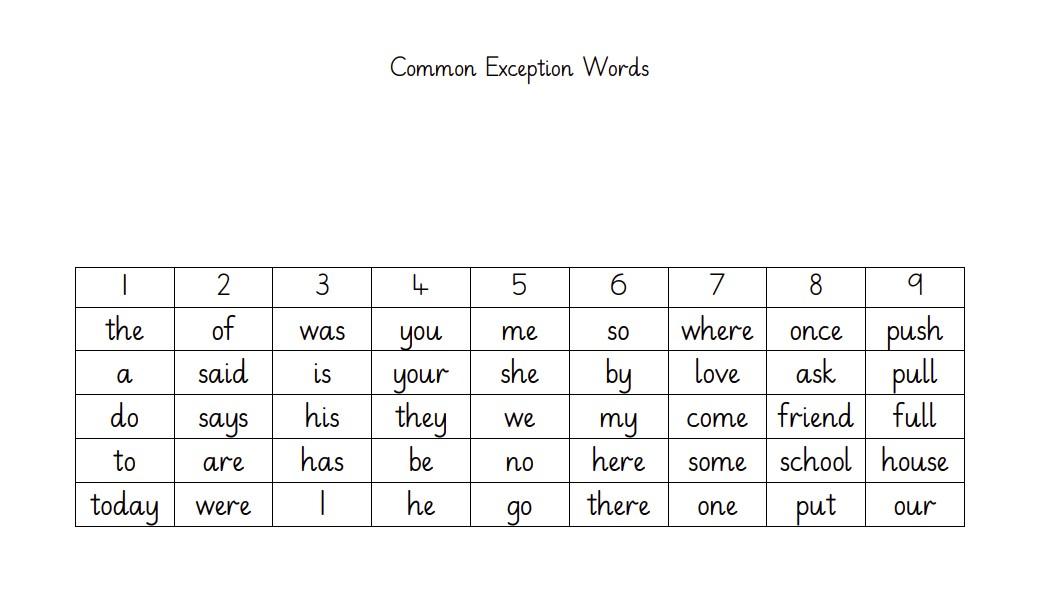
Common exception words
Attached to this letter you will find a list of all the words your child is expected to be able to spell by the end of Year 1. We recognise that some children will already know some or all of these words. We have deliberately started with the simpler words in order to build confidence and fluency. The expectation is that the children can not only spell these words but also use them within their own independent writing. There will be regular assessments to check progress and extension for those children who require it. Fridge magnet letters, whiteboards, scrabble letter tiles, iPad apps etc. are all great ways to practise the spelling of these words. As mentioned previously, please do let us know if you have any questions or worries. We want to support you to support your child.
Other information
The class will continue to have daily fruit provided in the morning. You may wish to supplement this with an additional healthy snack, for example, bread and butter. Your child will be able to drink during lessons but this should be water only and should be in a non-leaky water bottle.
Please could children bring their named wellies and waterproofs in, to be left at school for the times we spend outside.
PE with Mr Bain will be on Wednesday afternoons and they will have a second session on the same day as part of our outdoor learning in the woods. In the event that PE takes place on a different day we will inform you via class Dojo so they can come to school in their PE kits. Please do ensure that your child’s jumper is clearly named. We aim to learn outdoors as much as possible so, named, waterproof clothing and wellies are essential at all times please.
Mrs Thomsett teaches Monday-Wednesday and Ms Machray teaches on Thursdays and Fridays. You are always welcome to come and talk to either of us in school or message us on our working days. Thank you for your continued support.
Yours sincerely,
Mrs Becky Thomsett and Ms Georgina Machray
By the end of Year 1, your child should reach these Maths Objectives:
Number and Place Value
- Count to and across 100, forwards and backwards, from any given number.
- Count, read and write numbers to 100 in numerals.
- Count in multiples of twos, fives and tens.
- Identify one more and one less than a given number.
- Identify and represent numbers using objects and pictures.
- Use the language of equal to, more than, less than (fewer), most, least.
- Read and write numbers from 1 to 20 in numerals and words. Addition and Subtraction
- Read, write and interpret mathematical statements involving addition (+), subtraction (–) and equals (=) signs. · Use number bonds and related subtraction facts within 20.
- Add and subtract one-digit and two-digit numbers to 20.
- Solve one-step problems that involve addition and subtraction.
Multiplication and Division
- Solve one-step problems involving multiplication and division.
Fractions
- Recognise, find and name a half as one of two equal parts of an object, shape or quantity.
- Recognise find and name a quarter as one of four equal parts of an object, shape or quantity.
Measurement
- Compare, describe and solve practical problems involving different units of measurement.
- Measure and begin to record length, height, mass/weight, capacity, volume and time.
- Recognise and know the value of different coins and notes.
- Sequence events in chronological order using language (for example, before and after, next, first, today, yesterday, tomorrow, morning, afternoon and evening).
- Recognise and use language relating to dates, including days of the week, weeks, months and years.
- Tell the time to the hour and half past the hour and draw the hands on a clock face to show these times.
Geometry - properties of shapes
- Recognise and name common 2-D and 3-D shapes, including: - 2-D shapes (for example, rectangles (including squares), circles and triangles); - 3-D shapes (for example, cuboids (including cubes), pyramids and spheres).
Geometry - position and direction
- Describe position, direction and movement, including above, below, left, right, whole, half, quarter and three-quarter turns
Autumn 1 Knowledge Organiser


|
Year 1 Autumn 1 'How am I making History' | [pdf 547KB] |

|