Class 4 Autumn 2 2022
Dear Parents,
Welcome back to the second half of the Autumn term. With time changing, some may struggle to keep their spirits high, but we will be embarking on an exciting journey of learning this term that I hope will lighten the hearts of all our classmates and their families.
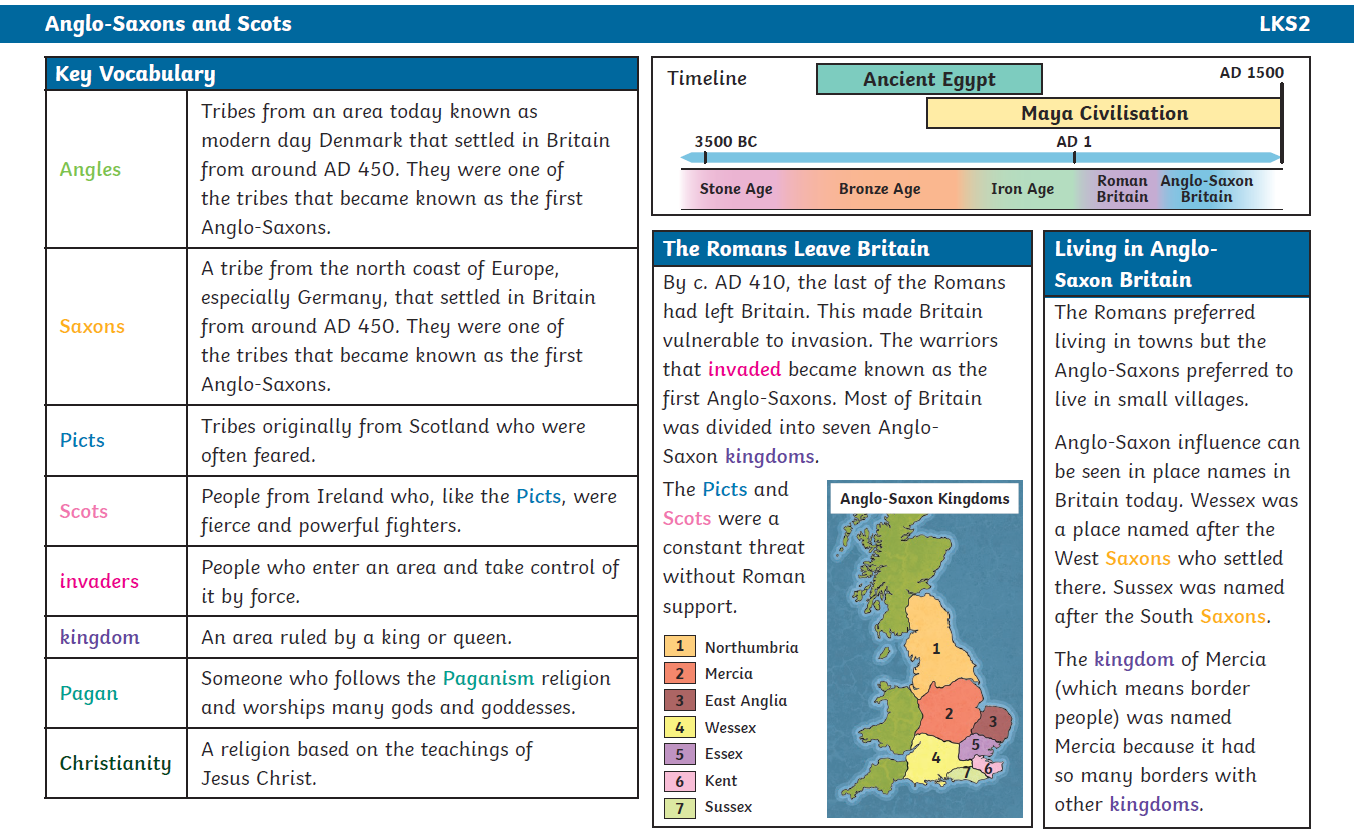
The Anglo-Saxons
This term’s history project is the Anglo-Saxons. On the school website, you will find a half term plan of the children’s learning and a Project map. Please bear in mind that the half term plan of learning has a degree of flexibility in its delivery. For example, objectives may be taught in different weeks than stated in the plan.
Next Monday, 7 November we will have a visitor in school, who will explore the Anglo-Saxons with your children, in a fun and interactive way. During this workshop the children will learn about the life of Alfred the Great. They will do some archaeology to uncover Anglo-Saxon coins and play a traditional game. There will also be an opportunity to complete a timeline, involving Anglo Saxon Runes and they will follow the trail of the Anglo-Saxon kings. To cover the cost of this workshop, please could you contribute £3? Payments can be made on ParentPay.
To further embed a knowledge of the Anglo-Saxons, I will be reading ‘Anglo-Saxon Boy’ by Tony Bradman, to the class. Should your child wish to read something extra at home, I can recommend ‘Beouwolf’ by Michael Morpurgo
English
In English we will be exploring fictional recounts through the storybook: ‘Little Mouse’s Big Book of Fears’ by Emily Gravett. As per my message on ClassDojo, it would be great if the children could please bring in a photo of themselves when they were younger, to use as part of a scrapbook that the class is putting together. Please could this be sent to school by Monday, 7 November?
Maths
This term in Maths, we will be focusing on Place Value and continuing to practice our times tables. We are currently revising the 8 times tables, and this will be followed by the 6- and then the 9-times tables. Although it helps if the children understand the concept of times tables i.e. how many groups of a number have been made (and we do practice this in school), our aim is for them to gain fluency in all the times tables by the end of Year 4. The best way to do this is through repeated, deliberate practice. Please could you encourage your child to play https://ttrockstars.com/ at home as well as https://www.topmarks.co.uk/maths-games/hit-the-button.
Each half term, we will alternate between the subjects of Art and Design Technology. This term we have DT and have decided to design an advent calendar ahead of Christmas. I would like to offer the children autonomy in deciding what they would like to make and will do my best to provide the equipment they will need e.g. a sewing machine or hot glue gun. If possible, please could you talk to your child about their design and help them to create a list and then source, the supplies they would need?
Parent consultations
I look forward to meeting with you in person next week Wednesday, 9 November, at the parent consultations. These meetings provide the opportunity to have a brief talk about your child and their progress in class. Please could I ask that, should you have a pressing matter you wish to discuss with me, that you drop me a message on ClassDojo in advance of us meeting, so that I can prepare to answer your questions? I think this will afford you the opportunity to make best use of your time with me.
Ms. Ticehurst and I are looking forward to the term ahead and want to thank you for your continued support.
Bronwyn Fulton (Year 4 class teacher)
Science and Foundation Subjects Medium Term Plan
|
|
Week 1 |
Week 2 |
Week 3 |
Week 4 |
Week 5 |
Week 6 |
|
Science |
Describe how igneous rock is created Explain what intrusive and extrusive igneous rocks are Know how to classify different types of igneous rock |
Describe what metamorphosis is Describe how metamorphic rock is formed Give the properties and uses of different metamorphic rock |
Describe how sedimentary rock is formed Describe how fossils are formed Explain how we can tell the age of a sedimentary rock |
Describe what a geologist is Describe how geologists classify rocks Draw an identification key for rocks |
Describe the effect that water can have on rocks Describe what chemical weathering is and what it does Explain how large earth movements can cause rocks to change |
Understand how the processes in the rock cycle fit together Know how to correctly order the processes in the rock cycle |
|
History
|
I can place events from the period studied on a timeline. I can use terms related to the period and begin to date events. I can understand more complex terms. e.g. BCE/AD.
|
I can use evidence to reconstruct life in the time studied. |
I can identify key features and events. I can look for links between times studied.
|
I can offer a reasonable explanation for some events.
|
I can look at the evidence available.
|
I can begin to evaluate the usefulness of different sources.
|
|
DT
|
PLANNING I can generate realistic ideas through discussion and design criteria for an appealing functional product fit for purpose and specific use.
|
PLANNING I can produce annotated sketches, prototypes, final product sketches and patterns. MAKING I can plan the main stages of making. Select and use a range of appropriate tools with some accuracy e.g. cutting, joining and finishing. |
MAKING I can select fabrics and fastenings according to their functional characteristics e.g. strength, and aesthetic qualities e.g. pattern. EVALUATING I can iInvestigate a range of 3-D textile products relevant to the project. TECHNICAL KNOWLEDGE AND UNDERSTANDING I know how to strengthen, stiffen and reinforce existing fabrics. I understand how to securely join two pieces of fabric together. I understand the need for patterns and seam allowances. I know and use technical vocabulary relevant to the project. |
MAKING Select fabrics and fastenings according to their functional characteristics e.g. strength, and aesthetic qualities e.g. pattern. EVALUATING Investigate a range of 3-D textile products relevant to the project. TECHNICAL KNOWLEDGE AND UNDERSTANDING I know how to strengthen, stiffen and reinforce existing fabrics. I understand how to securely join two pieces of fabric together.
|
EVALUATING I can test my product against the original design criteria and with the intended user. I can take into account others’ views. I understand how a key event or individual has influenced the development of the chosen product and or fabric. |
I can plan and then make a Christmas decoration. |
|
PE
|
I can create symmetrical shapes and balances. I can link symmetrical travelling movements and balances together with control and good body tension. |
I can perform and name different symmetrical jumps and rolls. I can link a jump, roll and balance in which all elements are symmetrical, with good body tension. |
I can create asymmetrical shapes, travelling movements and balances and link them together with good body tension. I can evaluate my work and those of others and suggest improvements. |
I can explore asymmetrical jumps and rolls. I can move from symmetrical into asymmetrical shapes with good body tension. |
I can create a sequence as detailed in the pupil challenge. |
I can evaluate your sequence from last week for improvement to the next level and practice for performance. |
|
Computing
|
I can use a digital device to research Spain and collect facts about the country. |
I can understand what happens when I search online? |
I can understand how companies encourage us to buy online |
I can understand fact, opinion or belief
|
I can understand what a bot is. |
I can be aware of what my Tech Timetable is like
|
|
Spanish
|
I can ask and answer simple questions with correct intonation. I can express opinions.
|
I can understand words displayed in the classroom. |
I can write familiar words and simple phrases from a model. |
I can remember a sequence of spoken words. |
I can initiate a conversation when working with a partner. |
I can research additional vocabulary using a dictionary. I can attempt spellings of familiar words. |
|
RSHE/RE
|
Respecting others I can explain what respect means I can show respect in a debate |
Respecting others I can show respect in a debate |
Respecting others I understand that there are limits to having freedom of opinion and speech I understand that we can disagree with an opinion but still respect someone |
Incarnation in Christianity Identify the difference between a ‘Gospel’, which tells the story of the life and teaching of Jesus, and a letter. Offer suggestions about what texts about baptism and Trinity might mean
|
Incarnation in Christianity Give examples of what these texts mean to some Christians today Describe how Christians show their beliefs about God the Trinity in worship (in baptism and prayer, for example) and in the way they live.
|
Incarnation in Christianity Make links between some Bible texts studied and the idea of God in Christianity, expressing clearly some ideas of their own about what the God of Christianity is like. Make links between some Bible texts studied and the idea of God in Christianity, expressing clearly some ideas of their own about what the God of Christianity is like.
|
|
Music |
Learn to play D-E-F-initely Revisit note names and length and introduce notes on the score. Make up own mnemonics to remember them. Learn about pulse. |
Learn to play Mardi Gras Groovin’ listen to this piece Mardi Gras Groovin’:play with note-names Mardi Gras Groovin’: play with note-names or notes or perhaps from memory Mardi Gras Groovin’: play from notation Copy back using the notes D and E
|
Musical Activities - use the notes C, D, E, F and G (G is a new note) Revisit theory from Stage 1: Pitch Two-Way Radio is a duet; a piece for 2 players or 2 groups - listen Two-Way Radio (note-names): Play part 2 Two-Way Radio (note-names): now all play part 1 Two-Way Radio: play each part with either note-names or notes then put them together Two-Way Radio: with notation. Put both parts together. Theory: Finding out about music - the language of music (semibreve) Rhythm game - Quiz: Rhythm & Countries |
Musical Activities - This piece uses the notes C, D, E, F and G Flea Fly: listen. Can you hear the mosquito in the track? Flea Fly: play with note-names. Play it several times and then try to play from memory Flea Fly: play again with notes or note-names Flea Fly: play with notation Theory: The Language of Music Finding Out About Music - Rhythm Game 2 |
Musical Activities - use the notes C, D, E and F with more complex rhythmic patterns: Rigadoon is an old dance tune written by Purcell. Find out some more information about him and his music. Rigadoon: listen once before you play Rigadoon: play with notes or note-names Rigadoon: play with notation Mamma Mia: listen then sing and play - have fun! Theory: Even more finding out about music - drag and drop 1. Finding out about song rhythms 2. Finding out about different pulses |
Create own compositions. Practise song for performance.
|
Autumn 2 Project Map