Class 6 Autumn 2 2022
Dear Parents and Carers,
Hello everyone! Hopefully this term we can have a healthier 7 weeks in the run up to Christmas. This term is always an exciting one based on our new history topic – War and Peace, as well as the always exciting run up to Christmas.
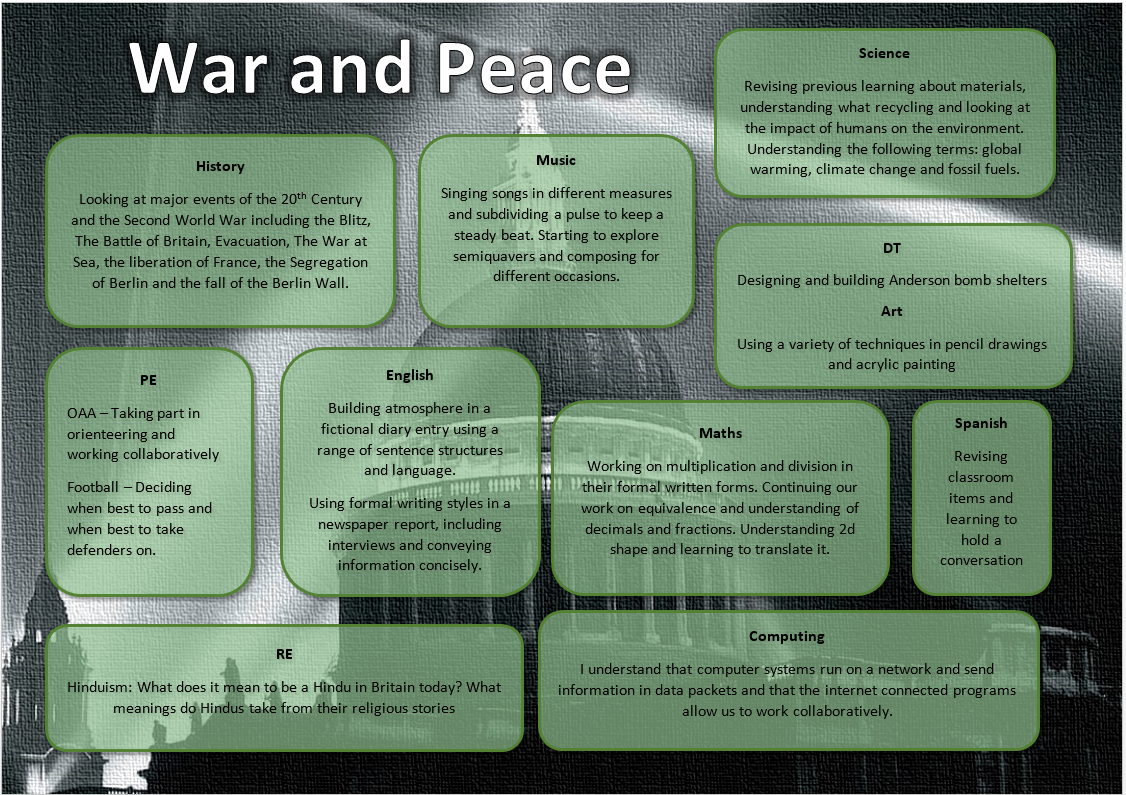
We have a history based topic this half term, where we will get stuck into some fascinating topics, like the battle of Britain and what that would have looked like and felt like from different viewpoints, the Holocaust, the end of the war and what that meant for the world and the Berlin Wall and its legacy for Europe.
A little housekeeping. The parents evening meetings will be on Thursday the 10th of November from 1pm. PE will continue to be on Tuesdays and Fridays. And we have an hour of outdoor learning on Tuesday afternoons as well. Children will need coats and wellies at the very least for these Tuesday sessions, with waterproof trousers being a preferable option – we intend to be out, whatever the weather! On these PE days, we are still coming in in PE kit (red top, black/dark shorts or trousers etc.) and school jumper.
Children will need coats, spare clothes and wellies, just as before, especially so now that the weather is becoming… wetter! The reason for this is so that we can use the extra space the field affords us, even in the winter and we don’t want to make all the floors really muddy by not changing our shoes! So wellies and coats are a must, please!
Can I remind you that there are a few things that should ideally happen at home on a regular basis:
Reading – children should be reading their books, but I’m happy with them reading anything, especially some non-fiction pieces, like Newsround articles, Wikipedia entries (dutifully fact checked, of course… J) and so on.
Times tables – children will be expected to be fluent in all tables up to 12x12, and related facts such as division and, for example, if we know 7x8 is 56, we know that 7x 0.8 is 5.6, and so on. I’ll give you some games and ideas about this at the parent meeting. After the first few days, the 6s, 7s, 8s and 9s are tables to look at in particular! I am always happy to talk to you, via Dojo messages or the phone or by email (tom@stoke-climsland.cornwall.sch.uk) whenever you need me. The best thing we can do to support these awesome children is to communicate as much as possible – so just reach out!
Thank you, in anticipation of your ongoing support,
Tom Lumby Danielle Young
Science and Foundation Subjects Medium Term Plan
|
|
Week 1 |
Week 2 |
Week 3 |
Week 4 |
Week 5 |
Week 6 |
|||||||
|
Science
|
|
||||||||||||
|
|
|
|
|
|
||||||||
|
History
|
I can place the current study on a time line in relation to other studies.
I can use relevant dates and terms.
I can sequence up to ten events on a time line.
|
I can find out about the beliefs, behaviour and characteristics of people, recognising that not everyone shares the same views and feelings. I can compare beliefs and behaviour with another period studied.
I can write an explanation of a past event in terms of cause and effect using evidence to support and illustrate my explanation.
|
I can link sources and work out how conclusions were arrived at.
I can consider ways of checking the accuracy of interpretation – fact, fiction or opinion.
I can be aware that different evidence will lead to different conclusions.
|
I can bring knowledge gathering from several sources together in a fluent account.
I can select an aspect of the study to make a display.
|
|
I can tell you key dates, characters and events studied.
|
|||||||
|
I can confidently use the library and ICT for research.
I can recognise primary and secondary sources.
I can use a range of sources to find out about an aspect of time past. I can suggest omissions and the means of finding out,
I can use a variety of ways to communicate knowledge and understanding including extended writing.
I can plan and carry out individual investigations.
|
|||||||||||||
|
|
|
|
|
|
|
|
|||||||
|
Art
|
I can use a variety of techniques to add effects, e.g. shadows, reflection, hatching and cross-hatching; \ I can depict movement and perspective in drawings; \ I can use a variety of tools and select the most appropriate;
|
I can create a colour palette, demonstrating mixing techniques; I can use a range of paint (acrylics) to create visually interesting pieces;
|
|||||||||||
|
DT
|
|
|
|
|
|
|
|||||||
|
|
|
||||||||||||
|
PE
|
|
||||||||||||
|
Computing
|
Communication and collaboration
I can understand that computer systems transfer information over networks in data packets
I understand that internet connected programs allow us to work together (collaborate)
Online relationships: I can demonstrate how I would support others (including those who are having difficulties) online. Online reputation: I can describe some simple ways that help build a positive online reputation. Online bullying: I can identify a range of ways to report concerns both in school and at home about online bullying.
|
||||||||||||
|
Music
|
|
||||||||||||
|
Spanish
|
Revision of greetings. Instructions. |
Revision of numbers 1-10. Numbers 10-31. |
Revision of instructions. Numbers to 31. Months. |
Days of the week. Months. Dates
|
Revision of greetings and classroom instructions |
Revision of greetings and classroom instructions |
|||||||
|
RE
|
|
||||||||||||
|
RSHE
|
|
||||||||||||
Autumn 2 Project Map