Class 6 Spring 1 2023
Dear Parents and Carers,
Happy New Year! I’d like to welcome Mrs Mary Breeze formally to our classroom – she will work with the children on Fridays, taking over from Mrs Young. With the holiday in our rear view mirror, it is time to look forward and start thinking about the rest of this year, specifically, building towards SATs. This week, children will do various parts of SATs papers, to give them both a flavour of what to expect, and to give us and idea of which elements of exam technique to work on, along with spotting any specific gaps in knowledge. This might be a good time to mention that the extra bank holiday we’ve been ‘granted’ for the coronation of King Charles III falls in SATs week – the 8th of May. While we will all enjoy the 3 day weekend, it has moved all of the tests – they will run from Tuesday to Friday now, instead of Monday through Thursday. While I wouldn’t presume to tell any of you what to do with that weekend, please do bear in mind that the children will have a big 4 day week, shortly after.
That being said, there are a few things that you can work on at home that will help prepare your child for that shortened week in May. First and most simply, reading – children should be reading their books, but I’m happy with them reading anything, especially some non-fiction pieces, like Newsround articles, Wikipedia entries (dutifully fact checked, of course… J) and so on. Secondly, times tables. The children need to be as fluent and accurate with their tables as possible, not just for May, but for secondary school as well. They should know all tables from their 1s to their 12s and everything in between. Practice for these in the car, over dinner, at breakfast or, if you’ve got the time, 5 minutes on the sofa! Questions such as:
What is 3 x 4? (12)
What is the product of 6 and 9? (54)
What is 42 divided by 7? (6)
What do I times 5 by to get 35? (7)
Is it possible to times two numbers together to make 48? (yes, 2x24, 4x12, 6x8)
It is best to focus on one type of question at a time – if this isn’t your cup of tea (not everyone like tables, even parents) there are lots of ways to practice on the computer too – I do recommend you sit with or are nearby to your child when doing this, to aid with……. Focus? J Hit the button, TTRS (please see attached log in details), BBC bitesize, Guardians of Mathematica are just a few that I could recommend.
Third, handwriting and spelling. This is also quite straightforward – read a sentence to your child, from their reading book or from the paper, a website – the content isn’t super important. The children will listen to you read it and write it down, with a focus on their handwriting and the spelling of words. Their book is a great place to read from because it will contain familiar but (hopefully) ambitious vocabulary. One or two sentences a day will help a lot – but it must be good practice. If the children practice their bad habits, this will only re-enforce them. Below is a typed example of handwriting.
Handwriting should be joined and fluent (shouldn’t take all day!) by the end of year 6. All lower case letters should be of a similar size, letters sitting neatly on the line, descenders like y p q and g should come under the line and ascenders like l k d t an h should reach the top of the line. Children should practice their
handwriting every morning in school too – so they should be very familiar with these patterns. See the attached sheet for some guidance.
The last thing that you can do with your children is some extra work at home. Attached to this letter is a grammar worksheet and a maths worksheet. As a rule of thumb, look at the number of questions or marks and use that as a guide to how many minutes it should take. You don’t have to work to a timer, but that is something coming up for the children so a little experience in comfortable settings will make a big difference. Some questions will be hard, some will be easy, but it is important to encourage children to work through it once by themselves, leaving questions they are not sure about. Then use the remaining time to have a go at the questions that they were uncertain of. Afterwards, it is most beneficial for you to work through the paper with them. Ask questions such as ‘how do you know that?’ or ‘can you show me another way?’ if children find a question easy. If they find it hard, work through it with them, or send them into school with it – we will endeavour to find a little time. J I will have new practice sheets ready every week – if you can’t do it one week, I won’t be tracking – the practice is for the children and building their confidence. While I don’t personally agree with homework, per say, I don’t want to sacrifice any of our other lessons to do more maths or English – we already do a lot!
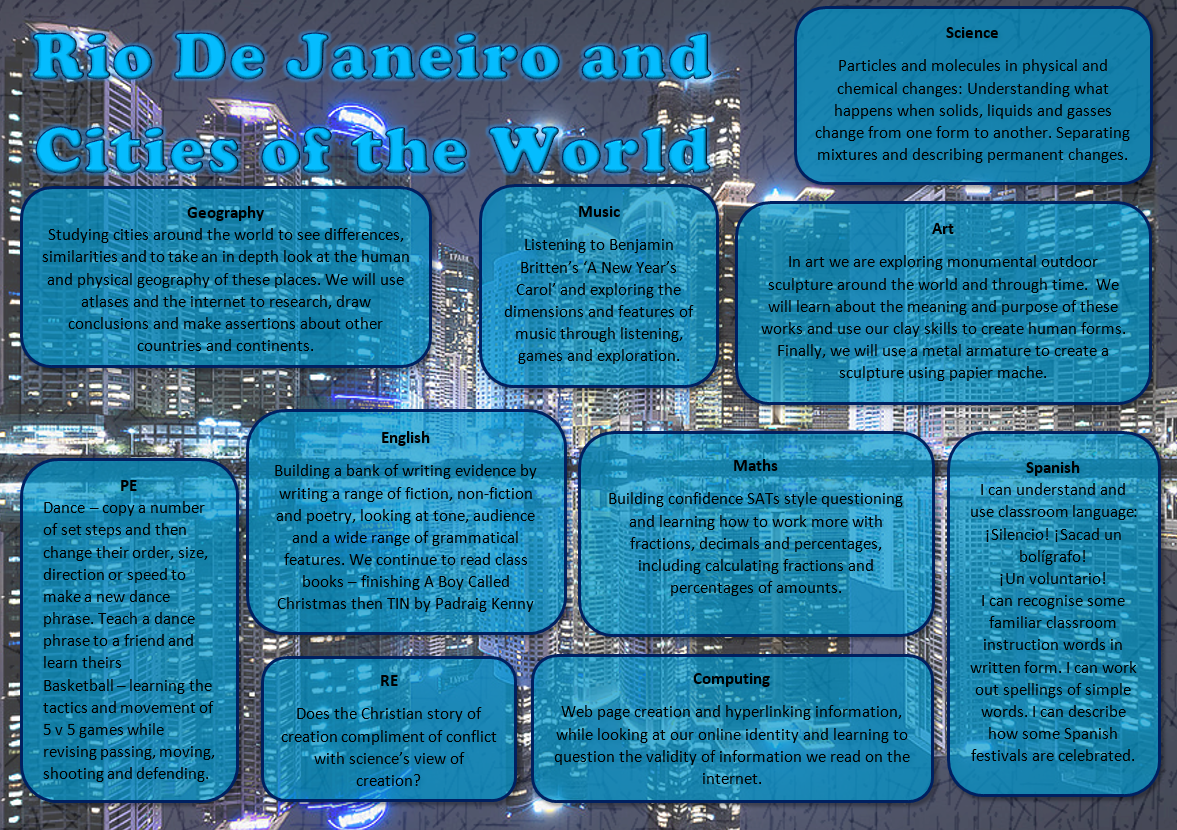
We have a geography based topic this half term, where we will look at a range of cities around the world, comparing them, finding out a little about where they have come from and why they are important in the modern world.
PE will continue to be on Tuesdays and Fridays and we have an hour of outdoor learning on Tuesday afternoons as well. Children will need coats and wellies at the very least for these Tuesday sessions, with waterproof trousers being a preferable option – we intend to be out, whatever the weather! On these PE days, we are still coming in in PE kit (red top, black/dark shorts or trousers etc.) and school jumper.
Children will need coats, spare clothes and wellies, just as before, especially so now that the weather is so wet! The reason for this is so that we can use the extra space the field affords us, even in the winter and we don’t want to make all the floors really muddy by not changing our shoes! So wellies and coats are a must, please! I am always happy to talk to you, via Dojo messages or the phone or by email (tom@stoke-climsland.cornwall.sch.uk, mbreeze@stoke-climsland.cornwall.sch.uk) whenever you need me. The best thing we can do to support these awesome children is to communicate as much as possible – so just reach out! I also try to be available outside the classroom as often as possible at the start and end of the day – please stop in for a chat! J
Thank you, in anticipation of your ongoing support,
Tom Lumby Mary Breeze
Spring 1 Project Map