Music Knowledge and Skills Progression Document
Calstock and Stoke Climsland Schools Federation
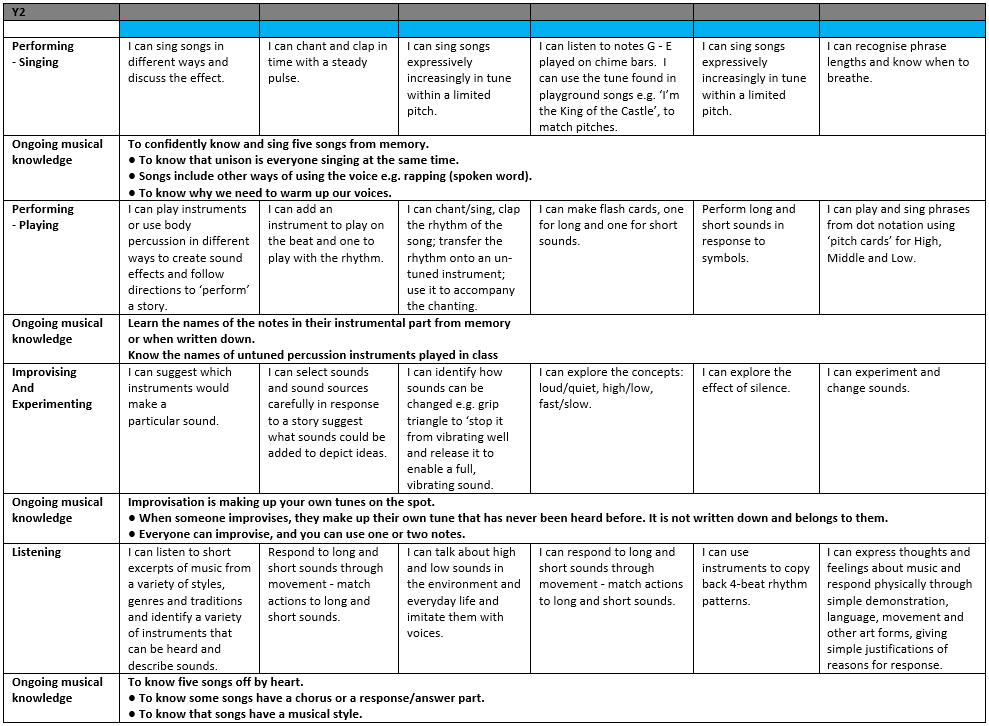
Music Knowledge and Skills Progression Document
Our Music curriculum is structured into the following key concepts:
- Performance – singing
- Performance – playing
- Improvising and Experimenting
- Composing
- Listening and Appraising
Our intention in the teaching of music is that as pupils progress, they should develop a critical engagement with music, allowing them to compose, listen and evaluate across a wide variety of historical periods, styles, traditions, and musical genres. We are committed to ensuring children understand the value and importance of music in the wider community and are able to use their musical skills, knowledge, and experiences to involve themselves in music, in a variety of different contexts.
End points
As a result of our music curriculum and provision we expect children at Calstock to be able to:
- perform, listen to, review and evaluate music
- sing, create and compose music
- understand and explore how music is created, produced and communicated
- We also expect children at Calstock to demonstrate a love of music and a genuine appreciation of a wide variety of different musical styles.
By the end of EYFS, children will be taught to:
- Listen carefully to rhymes and songs, paying attention to how they sound.
- Learn rhymes, poems and songs.
- Combine different movements with ease and fluency.
- Explore, use and refine a variety of artistic effects to express their ideas and feelings.
- Return to and build on their previous learning, refining ideas and developing their ability to represent them.
- Create collaboratively, sharing ideas, resources and skills.
- Listen attentively, move to and talk about music, expressing their feelings and responses.
- Sing in a group or on their own, increasingly matching the pitch and following the melody.
- Explore and engage in music making and dance, performing solo and in groups.
By the end of Key Stage 1, children will be taught to:
- use their voices expressively and creatively by singing songs and speaking chants and rhymes
- play tuned and un-tuned instruments musically
- experiment with, create, select and combine sounds using the inter-related dimensions of music
- listen with concentration and understanding to a range of high quality live and recorded music
By the end of Key Stage 2, children will be taught to:
- play and perform in solo and ensemble contexts, using their voices and playing musical instruments with increasing accuracy, fluency, control and expression
- play and perform in solo and ensemble contexts, using their voices and playing musical instruments with increasing accuracy, fluency, control and expression
- improvise and compose music for a range of purposes using the inter-related dimensions of music
- listen with attention to detail and recall sounds with increasing aural memory
- use and understand staff and other musical notations
- appreciate and understand a wide range of high quality music drawn from different traditions and from great composers and musicians
- develop an understanding of the history of music